

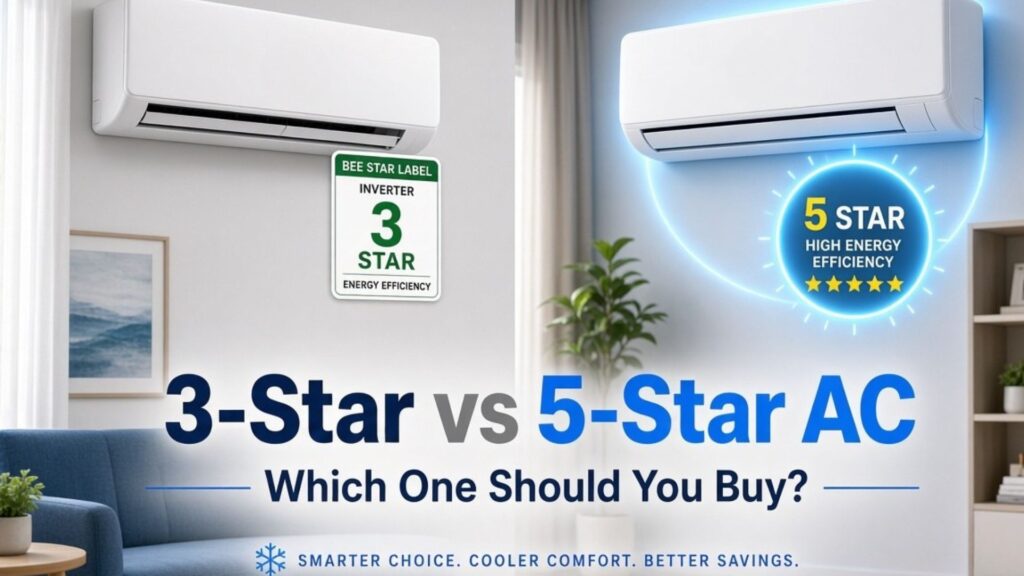
A 5-star AC is more energy efficient than a 3-star AC of the same capacity and can typically consume around 20% to 35% less electricity, depending on the specific models and operating conditions. A 3-star AC generally costs less upfront, while a 5-star AC can offer lower electricity costs over time, especially with frequent daily use.
3-Star vs 5-Star AC: What Is the Difference?
The main difference between a 3-star and 5-star AC is energy efficiency. A 5-star AC is designed to consume less electricity than a comparable 3-star model while providing similar cooling capacity.
As a general comparison, a 5-star AC can consume around 20% to 35% less electricity than a 3-star AC of the same capacity. The actual difference varies by model, energy-efficiency rating, usage pattern, operating conditions and other technical specifications.
This means the choice is essentially between:
- 3-star AC: Lower upfront cost but generally higher electricity consumption
- 5-star AC: Higher upfront cost but generally lower electricity consumption
- Frequent AC usage: A 5-star model can provide greater long-term savings
- Occasional AC usage: A 3-star model may offer better upfront value
However, star rating alone should not determine your purchase. Buyers should also compare the BEE label, ISEER, annual energy consumption, cooling capacity and inverter technology of the specific models.
How Much Electricity Does a 5-Star AC Save Compared With a 3-Star AC?
A 5-star AC can consume approximately 20% to 35% less electricity than a comparable 3-star AC, although the actual saving depends on the models being compared.
For example, if a 3-star AC consumes 1,200 units of electricity annually under a particular usage pattern, a comparable 5-star AC consuming 20% to 35% less could use approximately 780 to 960 units.
That represents a potential difference of around 240 to 420 units per year.
At an electricity rate of ₹8 per unit, that would correspond to approximately ₹1,920 to ₹3,360 in potential annual savings.
This is an illustrative calculation, not a guaranteed saving. Actual electricity consumption depends on factors such as operating hours, temperature settings, room insulation, outdoor temperature, AC capacity and the specific energy ratings of the two models.
For the most accurate comparison, check the annual energy consumption displayed on the BEE label for the exact AC models you are considering.
Why Does a 5-Star AC Consume Less Electricity?
A 5-star AC achieves greater energy efficiency through its overall design and energy-performance characteristics.
Modern air conditioners may use technologies such as:
- Inverter compressors
- Variable-speed operation
- More efficient heat exchangers
- Improved refrigerant systems
- Optimised airflow
- Advanced temperature control
However, inverter technology and star rating are not the same thing. An inverter AC can have different efficiency ratings, so consumers should compare the complete energy specifications rather than assuming that every inverter model will consume the same amount of electricity.
For air conditioners in India, BEE’s rating framework uses parameters such as ISEER (Indian Seasonal Energy Efficiency Ratio) to assess seasonal energy performance.
Is a 5-Star AC Worth the Extra Cost?
For frequent users, a 5-star AC can be worth the higher purchase price because the lower electricity consumption may help recover the additional investment over time.
For example, suppose:
- 3-star AC price = ₹40,000
- 5-star AC price = ₹52,000
- Additional investment = ₹12,000
- Estimated annual electricity saving = ₹3,000
The approximate payback period would be:
₹12,000 ÷ ₹3,000 = 4 years
After that point, the potential energy savings could provide additional financial benefit over the remaining operating life of the AC.
The actual payback period will vary considerably depending on electricity tariffs, operating hours and the energy consumption of the specific models.
Which Is Better for 8–10 Hours of Daily Use?
If you operate an AC for 8–10 hours every day, a 5-star model is generally worth considering.
Long operating hours mean electricity consumption becomes a significant part of the total cost of ownership. In this situation, paying more upfront for a more energy-efficient AC can potentially reduce running expenses over several years.
A 5-star AC is particularly worth evaluating for:
- Bedrooms with overnight operation
- Offices
- Hotels
- Retail spaces
- Clinics
- Commercial establishments
- Other spaces requiring extended cooling
For heavy usage, compare annual energy consumption rather than simply choosing an AC based on its purchase price.
Which Is Better for 3–4 Hours of Daily Use?
For 3–4 hours of daily use, a 3-star AC can be a practical option, particularly when the initial purchase budget is limited.
The electricity savings from a 5-star model may still exist, but the lower number of operating hours means the difference in annual running costs may be smaller.
However, if you plan to use the AC for many years, the higher efficiency of a 5-star model may still justify the additional upfront cost.
The best choice depends on the relationship between purchase price, annual electricity savings and expected years of use.
Is a 5-Star AC Always Better Than a 3-Star AC?
Not necessarily.
A 5-star AC has a higher energy-efficiency rating, but that does not automatically make it the best choice for every buyer.
A 5-star model is generally more suitable when:
- The AC is used for long hours
- Electricity costs are a major concern
- The AC will be used for several years
- Long-term operating costs matter more than initial price
A 3-star model can be suitable when:
- AC usage is occasional
- The initial budget is limited
- The AC is used for fewer hours
- Lower upfront cost is a priority
The right choice is therefore based on usage and total cost of ownership, not simply the number of stars.
How Should You Compare 3-Star and 5-Star ACs?
When comparing specific AC models, look at the following:
| Factor | 3-Star AC | 5-Star AC |
|---|---|---|
| Energy efficiency | Good | Higher |
| Electricity consumption | Generally higher | Generally lower |
| Upfront price | Usually lower | Usually higher |
| Long-term running cost | Generally higher | Generally lower |
| Best for | Moderate/occasional use | Frequent/heavy use |
| Potential electricity saving | — | Around 20%–35% vs comparable 3-star models |
| Long-term value | Good for lower usage | Better for higher usage |
The 20%–35% figure should be treated as a general comparison, not a guaranteed saving for every pair of ACs. Always check the energy-consumption figures of the actual models.
What Should You Check on the BEE Label?
The BEE label provides important information for comparing the energy performance of air conditioners.
Before purchasing, check:
Star Rating
A higher star rating indicates a higher energy-efficiency category.
ISEER
ISEER is an important seasonal efficiency metric for air conditioners under the BEE rating system.
Annual Energy Consumption
This helps estimate how much electricity the AC may consume under the conditions specified by the rating system.
Cooling Capacity
Make sure you are comparing ACs with similar cooling capacities.
Looking at these figures together provides a better comparison than relying on the star rating alone.
What AC Capacity Should You Choose?
Selecting the right AC capacity is essential for efficient cooling.
As a broad starting point, a small bedroom may require around 1 ton, a medium-sized room may often require around 1.5 tons, and larger rooms may need 2 tons or more.
However, room size is not the only consideration.
You should also account for:
- Ceiling height
- Number of occupants
- Sunlight exposure
- Windows and glazing
- Insulation
- Electronic equipment
- Local climate
- Heat generated inside the room
An AC that is too small may have to work harder to cool the space, while selecting excessive capacity may not necessarily provide the best efficiency.
What Should You Look for When Choosing AC Manufacturers in India?
The manufacturer is another important consideration, particularly for businesses and buyers purchasing multiple units.
When evaluating AC manufacturers in India, don’t look only at star ratings or advertised energy savings. Consider the manufacturer’s approach to:
- Product engineering
- Energy-efficiency compliance
- Component quality
- Compressor technology
- Cooling performance
- Manufacturing standards
- Product testing
- Warranty support
- After-sales service
- Availability of different capacities and applications
For Indian conditions, cooling equipment must also perform reliably across varying temperatures and usage environments.
For commercial buyers, hotels, offices and institutional applications, factors such as service support, reliability and long-term operating costs can be just as important as the initial purchase price.
3-Star vs 5-Star AC: Which One Should You Buy?
If you use your AC for several hours every day, a 5-star AC is generally the better long-term choice because of its higher energy efficiency and potentially lower electricity consumption. If you use your AC occasionally and want to minimise your initial investment, a 3-star AC can offer better upfront value.
Before buying, compare the BEE star rating, ISEER, annual energy consumption, cooling capacity, inverter technology, warranty and installation requirements of specific models.
If you’re looking for reliable cooling solutions for residential, commercial or institutional applications, Oscar India can help you evaluate the right specifications for your requirements. Contact Oscar India today to explore efficient cooling solutions from experienced AC manufacturers in India and find the right AC for your application.