

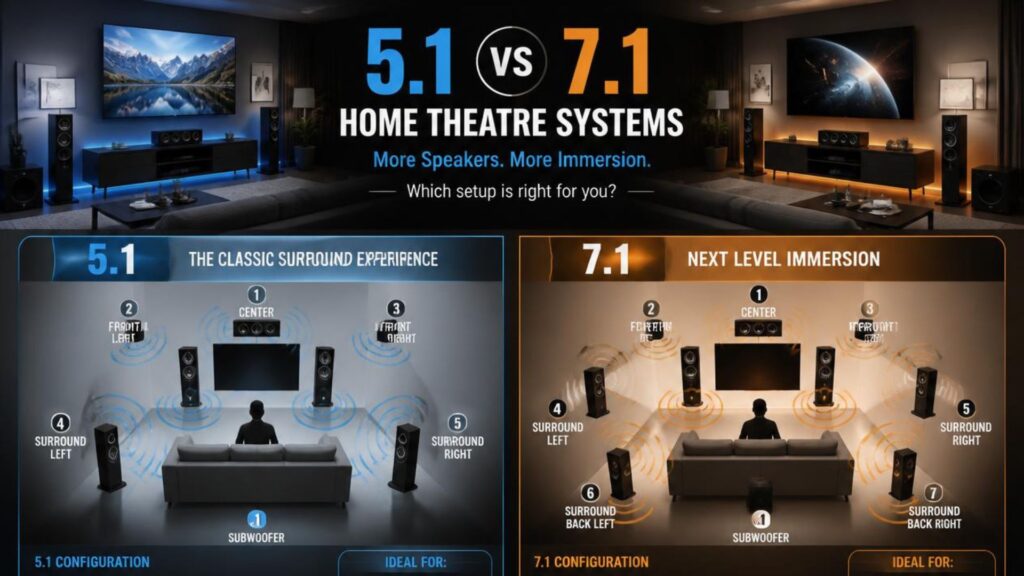
Choosing between a 5.1 and 7.1 home theatre system can significantly affect how you experience movies, gaming, sports, and music at home. While both configurations create surround sound using multiple speakers and a subwoofer, they differ mainly in the number of audio channels and how those speakers are positioned.
A 5.1 system has five main audio channels and one subwoofer, while a 7.1 system has seven main audio channels and one subwoofer. The two additional channels in a 7.1 setup provide greater separation for surround effects, but whether that difference is noticeable depends on your room, speaker placement, content, and equipment.
What Is a 5.1 Home Theatre System?
A 5.1 system consists of five main speakers and one subwoofer. It is one of the most common surround-sound configurations for home entertainment.
The typical speaker arrangement includes:
- Front left: Reproduces sound positioned to the left of the screen.
- Centre: Handles most dialogue and centre-positioned audio.
- Front right: Reproduces sound positioned to the right of the screen.
- Surround left: Adds effects from the left side of the listening area.
- Surround right: Adds effects from the right side.
- Subwoofer: Handles low-frequency sounds such as explosions, deep bass, and other low-end effects.
A 5.1 setup provides a good balance of immersive sound, manageable installation, and cost. It can work particularly well in bedrooms, living rooms, apartments, and medium-sized entertainment spaces.
What Is a 7.1 Home Theatre System?
A 7.1 system adds two additional surround channels to the five-channel configuration.
A typical 7.1 setup includes:
- Front left
- Centre
- Front right
- Surround left
- Surround right
- Rear left
- Rear right
- Subwoofer
The additional rear speakers help separate sounds coming from the sides from those coming from behind the listener. This can create a more continuous and precise surround-sound field.
For example, in an action movie, the movement of a car, aircraft, or other sound effect can travel from the front to the sides and then behind the listener with greater spatial detail.
However, the benefits of 7.1 are most noticeable when the room provides enough space for correct speaker positioning.
5.1 vs 7.1 Home Theatre: Key Differences
The most obvious difference is the number of audio channels, but there are several practical differences to consider.
| Feature | 5.1 System | 7.1 System |
|---|---|---|
| Main audio channels | 5 | 7 |
| Subwoofer | 1 | 1 |
| Surround speakers | 2 | 4 |
| Surround separation | Good | Greater |
| Speaker placement | Easier | More demanding |
| Room requirement | Small to medium | Medium to large |
| Installation | Simpler | More complex |
| Cost | Generally lower | Generally higher |
| Best suited for | Everyday home entertainment | Larger rooms and dedicated theatres |
Read More: https://www.oscarindia.in/ultimate-guide-to-home-theater-setup/
Is 7.1 Better Than 5.1?
Not necessarily. A 7.1 system has more audio channels, but more speakers do not automatically mean better sound quality.
A properly positioned and calibrated 5.1 system can deliver clear dialogue, directional effects, and powerful bass. In a small room, the difference between 5.1 and 7.1 may be relatively small because there may not be enough space to position the additional rear speakers effectively.
A 7.1 system becomes more beneficial when you have a larger room with sufficient space behind the seating position. The extra channels can create greater separation and make directional effects feel more natural.
The quality of the speakers, AV receiver, room acoustics, speaker placement, and calibration can all influence the final result.
How Should 5.1 and 7.1 Speakers Be Positioned?
Correct placement is essential for getting the most from either configuration.
For a 5.1 system, the front left and right speakers should be positioned on either side of the television or display, while the centre speaker should be close to the screen. The surround speakers are generally placed to the sides or slightly behind the main listening position.
For a 7.1 system, the side surround speakers are supplemented by two rear speakers behind the listening position. This requires more room and careful positioning to maintain separation between the channels.
Avoid placing all speakers at the same height or too close together. The listening position should ideally be centred within the sound field, and the system should be calibrated after installation.
Which Is Better for Movies: 5.1 or 7.1?
Both can provide an excellent movie-watching experience.
A 5.1 system is sufficient for many home movie setups. The centre speaker keeps dialogue focused, while the surround channels add environmental and directional effects. The subwoofer provides the low-frequency impact that makes explosions, music, and cinematic effects feel more powerful.
A 7.1 system can provide greater immersion in a larger room. The additional rear channels allow sounds to be positioned more precisely around the listener.
However, the benefit also depends on the audio format supported by the movie or streaming service. Not every piece of content provides native 7.1 audio, so having seven channels does not guarantee that every source will use all of them.
Is 5.1 or 7.1 Better for Gaming?
Both systems can provide immersive gaming audio.
A 7.1 setup can offer additional positional information when the game and gaming equipment support the relevant surround channels. This can help distinguish sounds coming from behind or moving around the player.
However, a correctly configured 5.1 system can still provide strong positional audio and may be more practical for a smaller gaming room.
Gamers should also check whether their console, PC, games, AV receiver, and other equipment support the audio configuration they plan to use.
Is 7.1 Worth It for a Small Room?
For most small rooms, 5.1 is usually the more practical choice.
A 7.1 system requires sufficient space behind the seating position for the additional rear speakers. If the sofa or chairs are directly against a wall, there may not be enough distance to create meaningful separation between the side and rear channels.
In this situation, spending more on two additional speakers may provide less benefit than investing in better speakers, room acoustics, an appropriate AV receiver, or professional calibration.
Is 5.1 Enough for a Home Theatre?
Yes. For many households, 5.1 is more than enough for an immersive home entertainment experience.
It offers:
- Easier installation
- Fewer speakers to position
- Lower equipment costs
- Good surround-sound performance
- Suitability for small and medium-sized rooms
- Compatibility with a wide range of movies, games, and television content
For people building their first surround-sound system, 5.1 can offer an excellent balance between performance, simplicity, and cost.
5.1 vs 7.1: Which Should You Choose?
Your room should be one of the first things you consider when choosing between the two.
Choose 5.1 if you:
- Have a small or medium-sized room.
- Want a simpler installation.
- Have limited space behind the seating area.
- Want effective surround sound without additional speakers.
- Are setting up your first home theatre system.
Choose 7.1 if you:
- Have a medium or large entertainment room.
- Have enough space behind the seating position.
- Want greater separation between surround effects.
- Frequently watch immersive movies or play compatible games.
- Are comfortable with a more complex speaker setup.
Ultimately, a well-designed 5.1 system can outperform a poorly positioned 7.1 system. Speaker quality, room acoustics, placement, receiver compatibility, and calibration are all important factors.
Final Thoughts
The choice between 5.1 and 7.1 is not simply about having more speakers. 5.1 is generally the better choice for smaller rooms and straightforward home entertainment setups, while 7.1 can be worthwhile in larger rooms where the additional rear channels have enough space to create meaningful separation.
Before buying a system, consider your room dimensions, seating position, available speaker locations, AV receiver compatibility, and the type of content you watch or play most often. Choosing a configuration that suits your room will generally deliver a better experience than selecting a system based only on the number of channels.
If you’re planning to upgrade or build a home theatre speaker, Oscar India can help you explore suitable audio and entertainment solutions based on your room, viewing preferences, and setup requirements.