

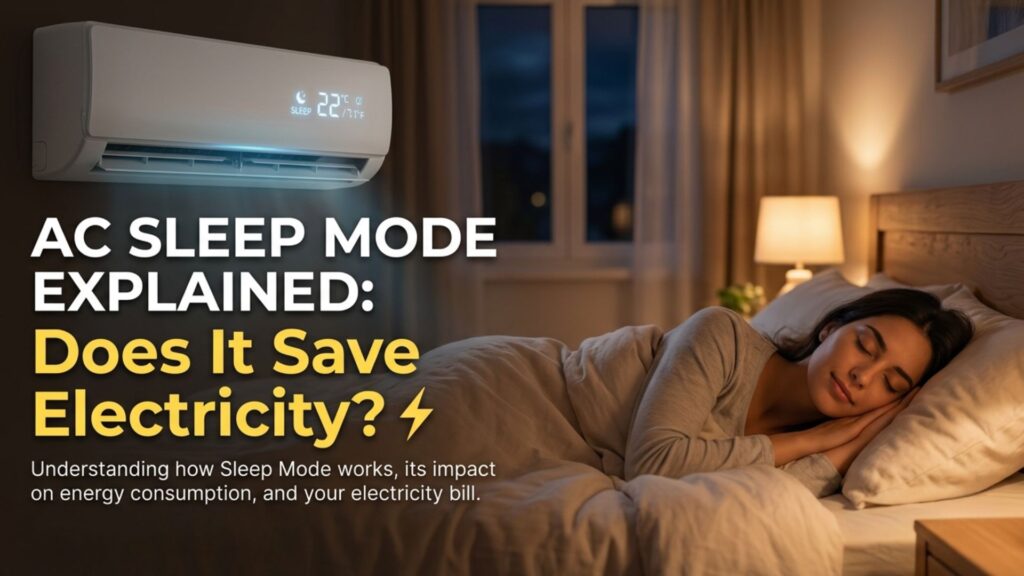
AC Sleep Mode can help reduce electricity consumption by gradually adjusting the temperature and reducing cooling demand during the night. Instead of maintaining the same low temperature for hours, the AC adapts its operation as you sleep. However, actual savings depend on the AC model, temperature setting, room conditions, weather and usage duration.
What Is Sleep Mode in an AC?
Sleep Mode is a feature designed to make air conditioning more comfortable and energy-conscious during nighttime use.
When activated, the AC typically changes its cooling operation gradually rather than maintaining the same temperature throughout the night. Depending on the model, it may increase the temperature setting, adjust fan speed or reduce compressor operation as cooling demand decreases.
The exact behaviour differs between AC models, so Sleep Mode should not be assumed to work in exactly the same way across every air conditioner.
How Does AC Sleep Mode Work?
Sleep Mode generally works by making gradual adjustments to the AC’s temperature or cooling operation after it is activated.
For example, if you initially set the AC to 24°C, Sleep Mode may gradually increase the target temperature during the night. This reduces the need to keep cooling the room to the same level while you are asleep.
Depending on the AC, Sleep Mode may:
- Gradually increase the temperature setting
- Reduce compressor operation
- Adjust fan speed
- Maintain a quieter cooling environment
- Reduce unnecessary cooling during the night
- Stop or change operation after a predetermined period on some models
The objective is to maintain reasonable comfort while avoiding excessive cooling.
Does AC Sleep Mode Actually Save Electricity?
Yes, Sleep Mode can reduce electricity consumption compared with running an AC continuously at a low fixed temperature, but the amount saved varies from one situation to another.
The main reason is that maintaining a lower indoor temperature requires more cooling than maintaining a moderately higher temperature.
For example, an AC running at a very low temperature throughout an eight-hour night may have a higher cooling demand than one that gradually increases its temperature setting using Sleep Mode.
However, Sleep Mode does not guarantee a fixed percentage of electricity savings. Actual consumption depends on factors such as the AC’s efficiency, room size, insulation, outdoor temperature, humidity and temperature setting.
A Simple Electricity Example
Suppose an AC averages 1 kWh of electricity consumption per hour under particular conditions.
If it operated at that average level for eight hours:
1 kWh × 8 hours = 8 kWh
If Sleep Mode reduces the AC’s average cooling demand during the night, its actual electricity consumption could be lower than this example. However, the precise saving cannot be calculated simply from Sleep Mode being switched on because compressor operation varies continuously.
This is why Sleep Mode should be considered an energy-saving feature, rather than a guarantee of a specific electricity reduction.
Why Can Sleep Mode Reduce AC Electricity Consumption?
Sleep Mode can help lower electricity use by reducing the amount of cooling the AC provides when the room no longer needs intensive temperature control. During the night, outdoor conditions may become cooler and your body may require less cooling, allowing the air conditioner to operate more moderately.
1. It Prevents Unnecessary Cooling
Once you fall asleep, you may not need the same level of cooling you wanted when first entering the room.
Sleep Mode can gradually adjust the temperature so that the AC does not continue providing aggressive cooling throughout the entire night.
2. It Can Reduce Compressor Work
The compressor is one of the major energy-consuming components of an air conditioner.
When cooling demand decreases, the AC may need less compressor operation. This can reduce the amount of electricity required to maintain comfortable conditions.
3. Outdoor Conditions May Become Cooler
Outdoor temperatures often decrease during the night. As the temperature difference between indoors and outdoors changes, the cooling requirement can also decrease.
Sleep Mode allows the AC to operate according to changing nighttime requirements rather than maintaining the same cooling target for the entire period.
4. It Helps Avoid Overcooling
A room that feels comfortable at bedtime may become uncomfortably cold several hours later if the AC remains at a very low setting.
Sleep Mode can help maintain a more moderate temperature while also reducing unnecessary cooling.
How Much Electricity Can Sleep Mode Save?
There is no universal electricity-saving percentage for AC Sleep Mode.
Two identical ACs can consume different amounts of electricity depending on where and how they are used.
Factors that affect electricity consumption include:
- AC capacity
- Inverter or non-inverter technology
- Energy efficiency rating
- Temperature setting
- Outdoor temperature
- Humidity
- Room size
- Insulation
- Number of occupants
- How frequently doors are opened
- AC maintenance
- Duration of operation
For this reason, claims such as “Sleep Mode always saves 20% electricity” should be treated cautiously unless they are supported by testing for a specific AC model and operating conditions.
Is Sleep Mode Better Than Running an AC at 22°C All Night?
For many users, yes.
Keeping an AC at 22°C throughout the night can create a greater cooling load than maintaining a higher temperature. If Sleep Mode gradually adjusts the temperature while keeping you comfortable, the AC may consume less electricity.
For example:
Normal Mode:
The AC remains set to 22°C for eight hours.
Sleep Mode:
The AC begins at a comfortable setting and gradually adjusts its cooling operation during the night.
The second approach can reduce cooling demand, particularly when the room does not need intensive cooling after the first few hours.
The key is not simply using Sleep Mode, but avoiding unnecessarily low temperature settings.
Sleep Mode vs Timer Mode: What’s the Difference?
Sleep Mode and Timer Mode are sometimes confused, but they serve different purposes.
Sleep Mode changes how the AC operates while you sleep. It may gradually adjust temperature, fan speed or compressor operation depending on the model.
Timer Mode is primarily used to schedule when the AC switches on or off.
For example, you could use a timer to switch the AC off after four hours, while Sleep Mode could continue adjusting the cooling conditions throughout the night.
Some ACs may allow both features to be used together.
Is Sleep Mode Useful on an Inverter AC?
Yes, Sleep Mode can be useful with an inverter AC.
An inverter AC can vary compressor speed according to cooling demand rather than simply operating at one fixed speed. When Sleep Mode reduces the cooling requirement, an inverter system can adjust its operation accordingly.
However, Sleep Mode and inverter technology are not the same thing.
An inverter AC can be energy efficient without Sleep Mode, while Sleep Mode can be available on different types of ACs depending on the manufacturer and model.
When choosing an air conditioner, it is therefore important to consider the overall efficiency and specifications of the unit rather than relying on Sleep Mode alone.
What Temperature Should You Set Your AC at Night?
A temperature of around 24–26°C can be a practical starting range for nighttime cooling, although the ideal setting depends on individual comfort and local conditions.
Instead of immediately setting the AC to a very low temperature, try a moderate setting and use Sleep Mode if your AC provides it.
You can also adjust the setting based on:
- Outdoor temperature
- Humidity
- Room insulation
- Bedding
- Number of people in the room
- Personal comfort
A comfortable moderate temperature can reduce the cooling load compared with maintaining an unnecessarily low temperature.
How Can You Save More Electricity While Using an AC at Night?
Sleep Mode is only one part of an energy-efficient cooling strategy.
Keep Doors and Windows Closed
Preventing cool air from escaping helps the AC maintain the desired indoor temperature without unnecessary cooling.
Clean the Air Filter
A dirty filter can restrict airflow and reduce cooling performance. Regular cleaning helps maintain proper airflow and system performance.
Avoid Extremely Low Settings
Setting an AC to a very low temperature does not necessarily make the room cool faster. It can increase the cooling requirement and potentially increase electricity consumption.
Select the Correct AC Capacity
An AC should be appropriately sized for the room. An undersized unit may have difficulty maintaining the desired temperature, while an oversized unit may not always operate optimally.
Maintain the AC Regularly
Regular maintenance helps identify issues affecting cooling performance and can help the system operate as intended.
Is AC Sleep Mode Worth Using?
Yes, Sleep Mode is worth using if you want comfortable nighttime cooling while potentially reducing unnecessary electricity consumption. Its main advantage is that it can adapt cooling operation as your needs change during the night instead of maintaining aggressive cooling continuously.
However, the biggest electricity savings come from combining Sleep Mode with sensible temperature settings, an appropriately sized and efficient AC, good room insulation and regular maintenance.
When buying a new air conditioner, look beyond individual features and consider efficiency, cooling capacity, technology, reliability and long-term operating costs. Choosing an experienced AC manufacturer can also help when comparing air-conditioning solutions for different cooling requirements.
For reliable and efficient cooling solutions designed for modern homes and businesses, explore Oscar India, offering air-conditioning products built around performance, comfort and energy-conscious operation.