

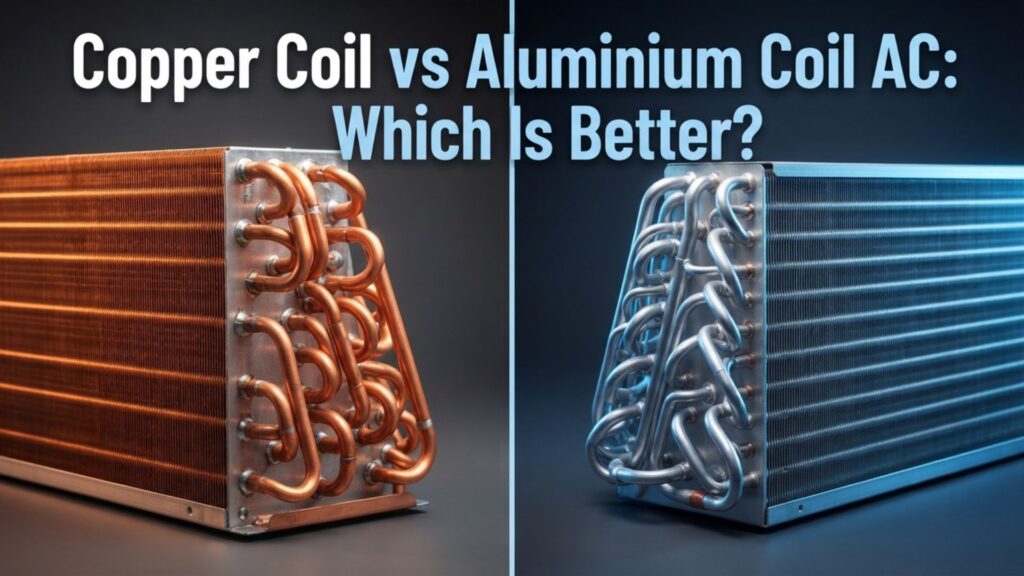
Copper coil ACs generally offer higher thermal conductivity and easier conventional repairability, while aluminium coil ACs are lightweight and can be more economical to manufacture. Both materials can provide effective cooling when properly engineered. The better choice depends on energy efficiency, corrosion protection, maintenance costs, warranty coverage and the air conditioner’s overall design.
Summary: Key Takeaways
- Copper coils: Higher thermal conductivity and generally easier conventional repairs.
- Aluminium coils: Lightweight, potentially lower material costs and suitable for compact heat exchanger designs.
- Cooling performance: Depends on the complete AC system, not coil material alone.
- Energy efficiency: BEE star ratings and ISEER values are more useful for comparing electricity consumption.
- Best choice: Consider copper for repairability and aluminium for suitable design and value, while comparing warranty and efficiency.
What Are Copper and Aluminium Coils in Air Conditioners?
Air conditioner coils are heat exchangers that transfer heat between refrigerant and surrounding air.
A typical split AC uses two main heat exchangers:
- Evaporator coil: Located in the indoor unit, it absorbs heat from indoor air.
- Condenser coil: Located in the outdoor unit, it releases heat into the surrounding environment.
Copper and aluminium are commonly used because both conduct heat efficiently.
Conventional heat exchangers often use copper tubes with aluminium fins, while some modern designs use all-aluminium microchannel construction.
Therefore, a copper coil AC does not necessarily contain copper in every part of its heat exchanger.
What Is the Difference Between Copper and Aluminium Coil ACs?
Copper and aluminium differ in thermal conductivity, weight, cost and repairability.
Copper vs Aluminium Coil Comparison
| Feature | Copper coil | Aluminium coil |
|---|---|---|
| Thermal conductivity | Higher | Lower |
| Material weight | Heavier | Lighter |
| Raw material cost | Generally higher | Generally lower |
| Repairability | Often easier to repair | Depends on construction |
| Corrosion resistance | Requires suitable protection | Requires suitable protection |
| Cooling performance | Depends on complete AC design | Depends on complete AC design |
| Maintenance | Regular cleaning and inspection | Regular cleaning and inspection |
While copper has advantages in material conductivity and conventional repairs, aluminium can perform effectively in appropriately designed heat exchangers.
How Much Better Is Copper at Conducting Heat?
Copper has significantly higher thermal conductivity than aluminium.
Thermal conductivity measures how readily heat passes through a material.
Thermal Conductivity Comparison
| Material | Approximate thermal conductivity |
|---|---|
| Copper | 400 W/m·K |
| Aluminium | 205–237 W/m·K |
Indicative values near room temperature. Actual conductivity varies with material purity, alloy composition and temperature.
Copper’s conductivity is approximately 1.7–2 times that of common high-conductivity aluminium materials.
However, this does not mean a copper coil AC cools twice as fast.
An air conditioner’s heat transfer depends on tube dimensions, fin design, airflow, refrigerant properties and the available heat-transfer surface.
Manufacturers can compensate for material differences through heat exchanger engineering.
Key takeaway: Copper conducts heat better as a material, but overall AC cooling efficiency must be evaluated at the system level.
Does a Copper Coil AC Provide Better Cooling?
Not automatically.
Copper’s high conductivity supports efficient heat transfer, but the actual cooling performance depends on the complete refrigeration system.
Important factors include:
- Compressor efficiency and cooling capacity
- Heat exchanger surface area
- Coil and fin design
- Refrigerant flow
- Indoor and outdoor airflow
- Installation and maintenance
For example, a properly engineered aluminium microchannel heat exchanger may provide competitive cooling performance compared with a conventional copper-tube design.
Similarly, dust accumulation on either type of coil can restrict airflow and reduce cooling efficiency.
When comparing air conditioners, review the rated cooling capacity and system efficiency rather than assuming that copper always provides better cooling.
Which AC Coil Is More Durable and Easier to Repair?
Both materials can provide reliable service life when manufactured, protected and maintained correctly.
Copper Coil Durability and Repairability
Copper refrigerant tubes are widely used in air conditioning systems.
One practical advantage is that certain copper-tube leaks can be repaired using appropriate brazing methods performed by trained technicians.
However, copper can still experience corrosion or damage under certain environmental conditions.
Aluminium Coil Durability and Repairability
Aluminium is lightweight and naturally develops a protective oxide layer.
Some all-aluminium designs also avoid direct contact between dissimilar metals within the heat exchanger, reducing particular galvanic corrosion risks.
However, aluminium microchannel heat exchangers can be difficult to repair using conventional techniques.
Depending on the damage and manufacturer recommendations, replacement may be necessary.
Neither material is universally more durable. Construction quality, protective treatments and operating conditions influence service life.
Which Coil Is More Energy Efficient?
Coil material alone cannot determine an air conditioner’s electricity consumption.
Although copper conducts heat more efficiently, overall energy performance depends on the compressor, heat exchanger design, refrigerant circuit and control system.
For Indian buyers, the Bureau of Energy Efficiency (BEE) star label provides a more useful comparison.
The label includes the Indian Seasonal Energy Efficiency Ratio (ISEER), which indicates seasonal cooling efficiency under specified testing conditions.
When comparing similar AC models, check:
- BEE star rating and applicable label period
- ISEER value
- Rated cooling capacity
- Labelled annual electricity consumption
- Inverter technology and operating characteristics
A well-designed aluminium-coil AC may consume less electricity than a less efficient copper-coil model.
Also, compare current energy labels carefully because BEE rating thresholds can change between rating periods.
Read More: https://www.oscarindia.in/inverter-ac-how-does-it-save-electricity/
Which AC Coil Is Better for Indian Weather Conditions?
India’s varied climate makes environmental protection an important purchasing consideration.
Hot and Dry Regions
Both copper and aluminium coil systems can provide suitable cooling.
Correct AC capacity, adequate condenser airflow and effective installation are particularly important during extreme summer temperatures.
Humid and Coastal Regions
Moisture and airborne salts can accelerate corrosion in air conditioning components.
Buyers should evaluate:
- Corrosion-resistant coil coatings
- Protection of outdoor components
- Installation and drainage arrangements
- Maintenance requirements
- Manufacturer warranty conditions
For coastal installations, suitable corrosion protection can be more important than choosing a material based solely on conductivity.
Which Is Better for Your Home: Copper or Aluminium Coil AC?
The better choice depends on your budget, service requirements and the performance of the complete AC system.
Practical Buying Decision Table
| Your priority | What to consider |
|---|---|
| Conventional repairability | Copper-tube designs may be preferable |
| Lower material weight | Aluminium heat exchangers offer an advantage |
| Energy savings | Compare BEE ratings and ISEER values |
| Coastal or humid environment | Prioritise corrosion protection and warranty |
| Long-term maintenance costs | Check repair options and spare-part availability |
| Budget-friendly purchase | Compare complete AC pricing and features |
| Reliable cooling | Evaluate capacity, efficiency and installation quality |
For example, if two AC models offer similar cooling capacity, energy efficiency and warranty terms, a copper-tube design may appeal to buyers who value conventional repair options.
However, an aluminium-coil AC with better energy efficiency, suitable corrosion protection and reliable service support may offer greater overall value.
The best buying decision depends on total ownership costs, not coil material alone.
What Should You Check Before Buying a Split AC?
Before purchasing a split air conditioner, consider the following specifications.
Cooling capacity: Select a suitable tonnage based on room size, sunlight exposure, insulation and occupancy.
Energy efficiency: Compare current BEE ratings and ISEER values.
Compressor technology: Check the system’s inverter capabilities and rated performance.
Coil construction: Confirm whether the AC uses copper tubes, aluminium heat exchangers or a combination.
Corrosion protection: Review protective coatings and warranty exclusions.
Service availability: Consider authorised servicing, replacement parts and installation support.
A reliable AC supplier should be able to provide complete technical specifications, allowing buyers to compare products beyond promotional claims.
Read More: https://www.oscarindia.in/how-to-choose-the-best-air-conditioner-for-home/
Which Is Better: Copper Coil or Aluminium Coil AC?
Choose copper when conventional repairability is a priority. Consider aluminium when the complete AC system offers suitable efficiency, corrosion protection, warranty coverage and value.
Neither material guarantees better cooling on its own.
For Indian households, cooling capacity, BEE energy efficiency, installation quality and long-term servicing should guide the final decision.
Oscar India offers inverter air conditioners with copper-coil construction and Blue Fin condenser protection in selected models. Buyers can explore the available range and compare individual product specifications.
If you are planning to upgrade your cooling system, explore Oscar India’s air conditioner collection and connect with a trusted AC supplier to choose a model suited to your room, climate and budget.