

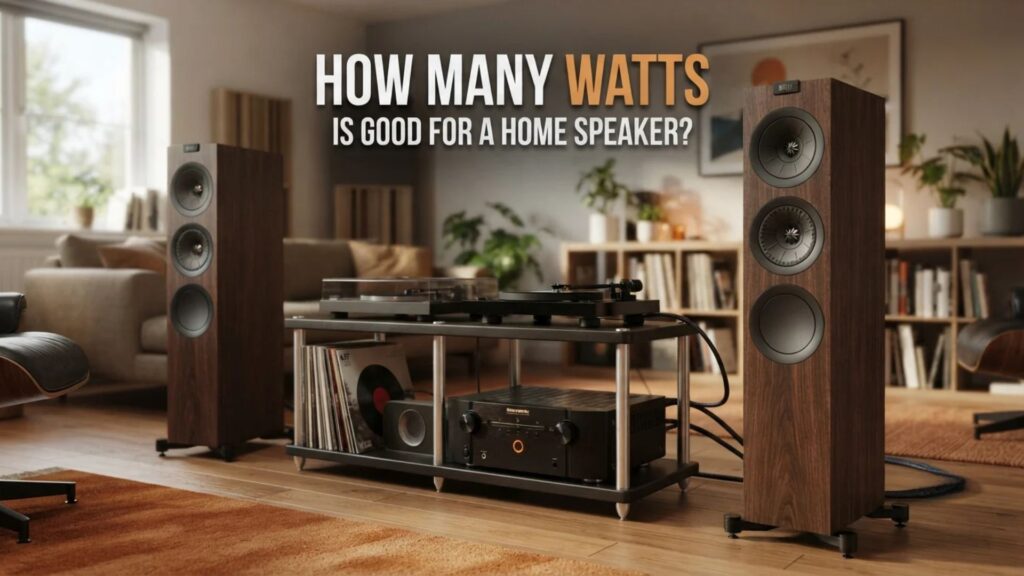
For most home listening setups, speakers with approximately 20–50 watts RMS can be sufficient for smaller rooms, while 50–100 watts RMS may suit larger living rooms and louder listening preferences. However, wattage alone does not determine sound quality or loudness. Speaker sensitivity, room size, amplifier performance and listening distance are equally important.
Summary: Key Takeaways
A good home speaker does not necessarily need high wattage. For everyday music, television and movies, moderate RMS power can provide satisfying sound, depending on speaker efficiency and room size. RMS ratings are more useful than peak-power claims when comparing speakers. Buyers should also consider sound clarity, bass performance, connectivity and the intended listening environment.
What Does Wattage Mean in Home Speakers?
Speaker wattage refers to electrical power, but its meaning depends on the type of speaker and the specification being quoted.
In a powered speaker, wattage commonly describes the amplifier’s rated output. In a passive speaker, it typically indicates how much electrical power the speaker is designed to handle.
Wattage is measured in watts (W) and helps buyers understand a speaker system’s power capabilities.
However, a 100-watt speaker is not automatically twice as loud as a 50-watt speaker.
Actual loudness depends on how efficiently the speaker converts electrical power into sound, its design and the listening environment.
When selecting the best home speaker, wattage should therefore be considered alongside other audio specifications.
How Many Watts Do You Need for a Home Speaker?
The ideal wattage depends on your room size, speaker efficiency and intended use.
A compact bedroom speaker does not necessarily require the same power as a system used for movies or gatherings in a large living room.
Recommended Speaker Wattage by Room Size
| Room or application | Indicative RMS power | Typical use |
|---|---|---|
| Small bedroom or study | 10–30 W | Background music, podcasts |
| Medium-sized room | 20–50 W | Everyday music and television |
| Living room | 50–100 W | Movies, gaming and music |
| Large living room | 80–150 W | Louder listening and entertainment |
| Home gatherings | 100 W or more | Higher-volume music playback |
These are broad illustrative ranges for total amplifier output in powered speaker systems, not fixed requirements. Actual needs vary with sensitivity, room acoustics, listening distance and the number of speakers.
For example, an efficient 40-watt system may sound louder than a less efficient system with a higher power rating.
Choosing a speaker based on the room and listening habits is more useful than simply selecting the largest wattage number.
What Is the Difference Between RMS and Peak Power in Speakers?
Understanding RMS and peak power is important when comparing home speakers.
RMS Power
RMS is commonly used in consumer audio specifications to describe continuous or sustained power capability.
For powered speakers, the RMS rating generally refers to the amplifier’s continuous output under specified conditions.
It provides a more meaningful basis for comparison than short-duration promotional power figures.
Peak Power
Peak power describes a speaker or amplifier’s short-duration power capability.
It does not indicate how much power the system can continuously deliver during normal use.
RMS vs Peak Power Comparison
| Feature | RMS or continuous power | Peak power |
|---|---|---|
| Meaning | Sustained rated power | Short-duration capability |
| Main purpose | Evaluating continuous performance | Describing temporary power limits |
| Buying relevance | Generally more useful | Limited without testing conditions |
| Comparison | Use consistent measurement conditions | Avoid treating as continuous output |
For example, a system advertised with a high peak-power figure may have a considerably lower continuous output rating.
Buying tip: Compare RMS power figures measured under similar conditions, including distortion levels, speaker impedance and the number of channels.
Does Higher Wattage Mean Better Sound Quality?
No. Higher wattage does not automatically mean better sound quality.
A speaker’s performance depends on several factors beyond amplifier output.
Speaker Sensitivity
Sensitivity describes how efficiently a speaker converts electrical power into sound.
It is commonly measured in decibels at a specified input and distance.
A speaker with higher sensitivity can produce greater sound pressure using the same amplifier power, assuming comparable measurement conditions.
Driver Quality
Speaker drivers reproduce different sound frequencies.
Well-designed woofers and tweeters contribute to bass reproduction, vocal clarity and high-frequency detail.
Their quality and integration matter more than wattage alone.
Cabinet Design
The speaker enclosure influences resonance, bass response and sound balance.
Poor cabinet design can produce unwanted vibrations even when the amplifier offers substantial power.
Amplifier Performance
An amplifier must deliver sufficient clean power without excessive distortion.
Increasing the volume beyond the amplifier’s capabilities can cause clipping and reduce sound quality.
For balanced audio, choose a speaker system with suitable power, good driver design and controlled distortion.
Is a 50-Watt Speaker Loud Enough for Home Use?
A 50-watt RMS powered speaker system can be sufficient for many bedrooms and medium-sized living rooms.
It may provide comfortable volume for music, television and everyday entertainment when designed efficiently.
However, the actual loudness depends on speaker sensitivity, listening distance and room acoustics.
For a basic comparison, doubling amplifier power produces approximately a 3-decibel increase in sound pressure level under otherwise identical conditions.
This means moving from 50 watts to 100 watts does not make the speaker twice as loud.
The additional power may provide more headroom for louder musical passages, but it cannot compensate for poor speaker design.
How Does Speaker Wattage Affect Bass Performance?
Higher amplifier power can help a suitable speaker reproduce demanding bass passages at louder volumes.
However, wattage alone does not determine bass depth or quality.
Bass performance also depends on:
- Woofer size and design: Influence low-frequency output capability.
- Speaker enclosure: Affects bass extension and resonance.
- Amplifier control: Helps maintain clean reproduction at higher volumes.
- Subwoofer integration: Supports deeper low-frequency effects.
- Room placement: Changes how bass is experienced at the listening position.
A well-designed speaker with moderate power and a suitable subwoofer may produce more satisfying bass than a higher-wattage speaker with limited low-frequency capability.
For music and movies, balanced bass is often more enjoyable than excessive booming.
Which Home Speaker System Should You Choose?
Different speaker configurations suit different listening requirements.
| Speaker type | Main advantage | Suitable application |
|---|---|---|
| 2.0 stereo speakers | Left and right audio channels | Music and everyday listening |
| 2.1 speaker system | Stereo speakers with a subwoofer | Music, television and bass-focused playback |
| 4.1 multimedia system | Four speakers and a subwoofer | Multi-speaker entertainment setups |
| 5.1 home theatre system | Dedicated surround channels and subwoofer | Movies and surround sound |
| Tower speaker | Larger enclosure with multiple drivers in some designs | Living rooms and entertainment spaces |
A 2.1 speaker system may be sufficient for everyday music and television.
For immersive movie sound, a properly configured 5.1 home theatre system can offer more distinct surround effects.
Tower speakers may suit buyers looking for a larger entertainment system, depending on their placement and acoustic performance.
What Should You Check Before Buying a Home Speaker?
Wattage is only one part of selecting a suitable speaker.
Consider the following before making a purchase.
Sound clarity: Listen for natural vocals, balanced instruments and controlled bass.
RMS power: Compare continuous output ratings rather than relying on peak-power figures.
Connectivity: Check for Bluetooth, USB, AUX, optical or HDMI ARC support, depending on your devices and the specific model.
Room compatibility: Consider the available floor space, speaker placement and listening distance.
Audio features: Look for suitable equaliser controls, remote operation or karaoke features if required.
Brand support: Check warranty terms, service availability and product specifications.
The best choice is a system that meets your listening needs without unnecessary power or features.
How Do Real Speaker Wattage Ratings Compare?
Comparing actual speaker specifications helps explain how power ratings differ across home audio systems.
For example, consider these models from Oscar India’s home audio range:
| Speaker model | Configuration | Rated RMS power |
|---|---|---|
| Oscar OSC-214 EN | 2.1 home theatre | 20 W |
| Oscar OSC-421 EN | 4.1 home theatre | 70 W |
| Oscar OSC TR-10X2 | 2.0 tower speaker | 80 W |
These ratings represent different system configurations and amplifier power levels.
However, the numbers alone cannot establish which model produces better sound or is more suitable for a particular room.
A 20-watt system may meet the needs of someone listening at moderate volume, while a higher-powered system may offer additional output capability for larger spaces or louder playback.
Buyers should also compare speaker sensitivity where specified, driver design, connectivity and listening requirements before making a decision.
How Can You Choose the Right Speaker Wattage for Your Home?
The right speaker wattage depends on how you plan to use the system, the size of your room and your preferred listening volume.
For smaller spaces, a moderate-power system may be sufficient. Larger rooms or louder entertainment requirements may benefit from additional amplifier power and suitable speaker drivers.
Prioritise continuous power ratings, sound clarity, bass performance and useful connectivity features.
If you are exploring the best home speaker for music, movies or everyday entertainment, discover Oscar India’s range of multimedia speakers, tower speakers and home theatre systems. Compare available models and choose a system that suits your space, listening preferences and budget.