

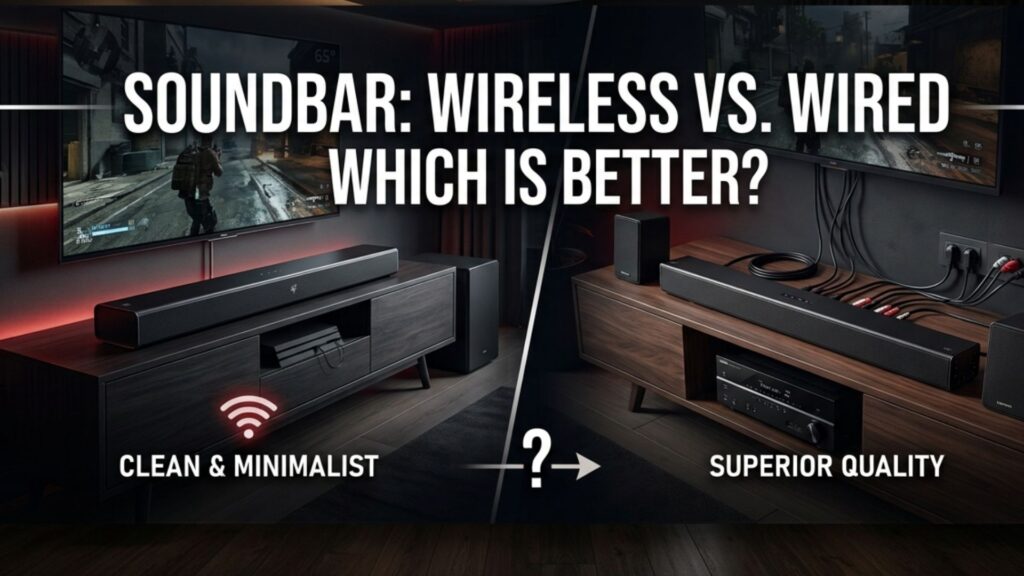
Wired soundbars offer reliable, low-latency audio and can be more affordable, while wireless soundbars provide flexible placement, fewer cables and greater convenience. The better choice depends on your priorities: choose wired connectivity for a stable TV or gaming setup, or wireless for a cleaner, more flexible entertainment system.
A soundbar can make TV dialogue clearer, add depth to films and create a more immersive listening experience than built-in TV speakers. But choosing the right one involves more than comparing speaker specifications.
One of the main decisions is whether to choose a wireless soundbar or wired soundbar. The connection affects installation and flexibility, but factors such as audio formats, speaker configuration, room size and intended use can be just as important.
What is the difference between a wireless and wired soundbar?
A wired soundbar uses a physical connection between the TV and soundbar, usually through HDMI ARC/eARC or optical audio. A wireless soundbar can use Bluetooth or Wi-Fi for compatible connections.
Wireless does not mean completely cable-free. The soundbar still needs power, and some systems combine wireless connections with wired ones.
| Feature | Wireless Soundbar | Wired Soundbar |
|---|---|---|
| Audio connection | Bluetooth or Wi-Fi, depending on model | HDMI ARC/eARC, optical or other wired connections |
| Cable management | Fewer audio cables | Requires audio cable |
| Placement | More flexible | More dependent on cable routing |
| Latency | Depends on technology and implementation | Generally low |
| Connection stability | Can vary with wireless environment | Generally consistent |
| Music streaming | Often convenient | Depends on model |
| Gaming | Check latency and compatibility | Direct connection can be preferable |
| Home theatre | Flexible with compatible systems | Well suited to fixed setups |
Is a wireless soundbar better than a wired soundbar?
Neither is automatically better. The right choice depends on how your entertainment system is used.
Wireless models are useful when you want a cleaner installation, flexible placement or convenient music streaming. Wired models can make more sense when you want a direct connection for a fixed TV or gaming setup.
The distinction becomes clearer when you consider how each option performs in real-world use.
What are the advantages of a wireless soundbar?
A wireless soundbar can simplify an entertainment setup without requiring you to sacrifice the core benefits of a dedicated audio system.
Cleaner installation
Fewer audio cables can make a noticeable difference in a living room, particularly when the TV is wall-mounted.
You will still need a power cable, but removing the audio cable between compatible devices can make the setup look less cluttered.
Flexible placement
Wireless connectivity gives you more freedom when arranging your entertainment equipment. You are less restricted by the length and routing of an audio cable.
This can be useful when the TV is positioned away from the main furniture or when you expect to rearrange the room.
Convenient music streaming
Bluetooth-enabled models can connect to compatible smartphones and tablets, making the soundbar useful beyond TV viewing.
Some Wi-Fi-enabled systems can provide additional network-based streaming features, depending on the model.
Wireless speaker expansion
Some soundbar systems use proprietary wireless connections for compatible subwoofers or rear speakers. This can reduce the need to run speaker cables around a room when creating a more immersive setup.
What are the disadvantages of a wireless soundbar?
The convenience of wireless audio comes with a few technical considerations, particularly for users with demanding setups.
Latency can vary
Latency is the delay between an audio signal being transmitted and heard. Its impact depends on the wireless technology, codecs, source device and soundbar.
A small delay may be unnoticeable during everyday TV viewing but can become more apparent during gaming, where audio needs to remain closely synchronised with on-screen action.
Wireless interference
Bluetooth and Wi-Fi operate alongside other wireless devices. Routers, Bluetooth equipment and a crowded wireless environment can sometimes affect connection performance.
The impact varies by room, distance and equipment, so wireless performance should be considered alongside the specifications of the particular soundbar.
Compatibility needs checking
A TV may support Bluetooth without supporting every type of Bluetooth audio connection. Similarly, Wi-Fi features may depend on the soundbar’s specific ecosystem.
Checking compatibility between the TV and soundbar before purchase can prevent connection issues later.
Read More: https://www.oscarindia.in/soundbar-vs-speakers-which-is-better/
Why choose a wired soundbar?
Wired soundbars remain a practical option when you want a direct connection and are not concerned about running an audio cable.
They can be particularly useful for fixed entertainment units, gaming setups and home theatre systems where placement is already established.
HDMI ARC and eARC
HDMI ARC (Audio Return Channel) allows a compatible TV to send audio to a soundbar through HDMI.
HDMI eARC (Enhanced Audio Return Channel) offers greater bandwidth than ARC and can support higher-quality audio formats, including compatible lossless audio.
If both your TV and soundbar support eARC, it can be an important consideration when building a higher-end home theatre setup.
Reliable audio timing
A direct wired connection avoids some of the latency variables associated with wireless transmission.
This can be useful for gaming and other situations where close audio-video synchronisation matters.
Consistent connection
Unlike wireless connections, a physical audio cable is not affected by Wi-Fi congestion or Bluetooth interference.
For a soundbar that will stay in one position, this can make a wired setup straightforward and dependable.
Read More: https://www.oscarindia.in/hdmi-arc-vs-optical-cable-which-is-better-for-a-soundbar/
What are the disadvantages of a wired soundbar?
The main trade-off is convenience rather than audio capability.
Cable management
The audio cable needs to run between the TV and soundbar. Depending on the layout, it may need to be hidden behind furniture or routed through a wall.
This is especially relevant for wall-mounted televisions.
Less flexibility
Moving the soundbar or TV may require changing the cable routing. This is less of an issue for a permanent entertainment unit but can matter if you frequently rearrange your room.
Does wireless or wired connectivity affect sound quality?
Not by itself.
Sound quality depends on several factors, including speaker configuration, amplifier performance, acoustic design, digital signal processing and room placement.
Supported audio formats also matter. Features such as Dolby Atmos and DTS:X can contribute to a more immersive home theatre experience when the soundbar, TV and content source support them.
This means a well-designed wireless soundbar can deliver an excellent listening experience, while a wired connection does not automatically make a soundbar sound better.
Which is better for gaming?
Gaming places greater importance on audio timing than many other forms of entertainment.
A wired connection can be useful when you want to minimise variables that could introduce audio delay. However, a wireless soundbar can also work well for casual gaming when its wireless implementation and connected devices provide suitable synchronisation.
If gaming is a major use case, check the soundbar’s latency characteristics and connection options rather than choosing solely between wireless and wired.
Which is better for a TV?
Both options can work well as a soundbar for TV. Your room and viewing habits should guide the decision.
For a minimalist living room, wireless connectivity can make installation and placement easier. For a fixed entertainment unit, wired connectivity may be more practical, particularly if HDMI ARC or eARC is available.
Think about how the soundbar will be used rather than treating one connection type as universally superior.
Read More: https://www.oscarindia.in/how-to-connect-soundbar-to-smart-tv/
What should you check before buying a soundbar?
Once you have decided which type of setup suits you, look at the features that will have the biggest impact on your experience.
TV compatibility
Check the ports and audio technologies supported by your TV and make sure the soundbar offers a suitable connection.
Audio formats
If immersive audio is important to you, check support for formats such as Dolby Atmos and DTS:X, along with compatibility across your TV and content sources.
Speaker configuration
Consider the soundbar’s channel configuration, speaker arrangement and whether it includes or supports a separate subwoofer or rear speakers.
Room size and placement
Think about the size and shape of the room and where the soundbar will sit. Placement can affect how effectively the system creates a wider and more immersive soundstage.
Primary use
Your main use should influence the decision. Film and TV viewers may prioritise dialogue and immersive audio, music listeners may value streaming features, while gamers may place greater importance on latency and synchronisation.
Wireless Soundbar vs. Wired: Which should you choose?
A wireless soundbar can be a practical choice when you value a clean setup, flexible placement and convenient streaming. A wired soundbar can suit fixed entertainment systems where direct connectivity and reliable audio timing are more important.
There is no need to choose based on connectivity alone. Compare the soundbar’s audio performance, supported formats, speaker configuration, TV compatibility and intended use before making a decision. Explore Oscar India’s soundbar range to find an option that fits your TV setup, room and everyday entertainment needs.